Subject: Comprehensive Assessment of Georgia’s EU Accession Freeze, Domestic Stability, and Geopolitical Realignment
Executive Summary: The Structural Dissolution of the “European Dream”
By the conclusion of 2025, the Republic of Georgia has traversed a trajectory of dramatic geopolitical realignment, marking perhaps the most significant structural shift in the South Caucasus since the 2008 Russo-Georgian War. Once widely regarded as the “front-runner” of the European Union’s Eastern Partnership—a beacon of democratic transformation and institutional reform in the post-Soviet space—Georgia has, over the course of the preceding eighteen months, entered a period of protracted and likely systemic estrangement from its traditional Western partners. The catalyst for this rupture, anchored in the ruling Georgian Dream (GD) party’s consolidation of power through the contested October 2024 parliamentary elections and subsequent legislative maneuvers, has resulted in the de facto and de jure freezing of Georgia’s European Union accession process.
As of December 2025, the European Commission officially classifies Georgia as a “candidate country in name only,” a designation without precedent in the history of EU enlargement that underscores the severity of the diplomatic collapse. The bilateral relationship has deteriorated from a “Strategic Partnership” to a confrontational standoff, characterized by the suspension of direct financial aid, the freezing of defense cooperation under the European Peace Facility, and the imminent activation of legal mechanisms that threaten the visa-free travel regime enjoyed by Georgian citizens since 2017.
This report posits that the developments of 2024–2025 do not represent a temporary tactical pause by Tbilisi, but rather a fundamental strategic pivot. The Georgian government, under the de facto leadership of billionaire founder Bidzina Ivanishvili and the premiership of Irakli Kobakhidze, has engaged in a “sovereigntist” recalibration. This strategy prioritizes regime survival and economic pragmatism—anchored by deepened ties with the People’s Republic of China and a transactional détente with the Russian Federation—over adherence to the normative conditionality of Euro-Atlantic integration. The awarding of the strategic Anaklia Deep Sea Port project to a Chinese consortium and the violent suppression of pro-European protests signify the materialization of this pivot.
The following analysis provides an exhaustive examination of the structural inputs driving this crisis, the forensic details of the 2024 elections, the mechanics of the “foreign influence” legislation, the sociology of the 2025 resistance movement, and the profound implications for regional security in the Black Sea basin.
Section 1: The Accession Freeze — Anatomy of a Diplomatic Collapse
1.1 From Frontrunner to “Candidate in Name Only”
The release of the European Commission’s 2025 Enlargement Policy Communication on November 4, 2025, marked the formalization of the rupture between Brussels and Tbilisi. While the European Union granted Georgia official candidate status in December 2023, the subsequent year witnessed a rapid dismantling of the institutional trust and political will required to sustain that status. The 2025 report serves as a “stark assessment,” concluding that the Georgian government’s actions have not only stalled the process but actively diverted the country from its constitutional European trajectory.
For the first time, the Commission utilized the terminology “candidate country in name only” to describe Georgia’s status. This rhetorical escalation reflects a harsh legal and bureaucratic reality: the accession process is frozen. The European Council had already concluded in June and October 2024 that the government’s trajectory was incompatible with EU values, but the 2025 report codified this backlash, citing “serious democratic backsliding” and “anti-EU rhetoric” that mirrors Russian-style disinformation campaigns.
Table 1.1: Comparative Accession Status in the Eastern Neighborhood (December 2025)
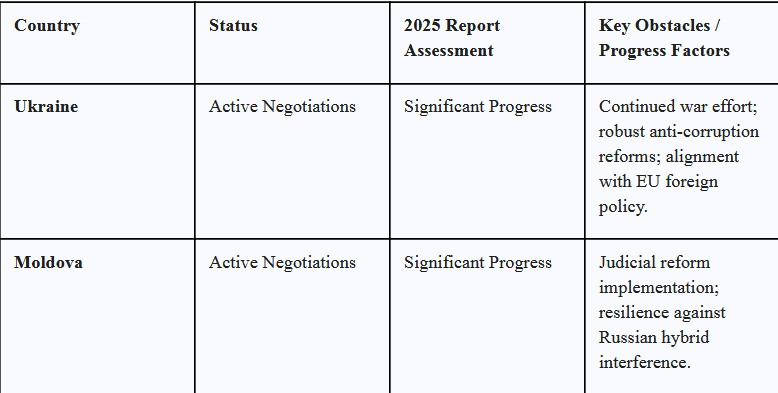
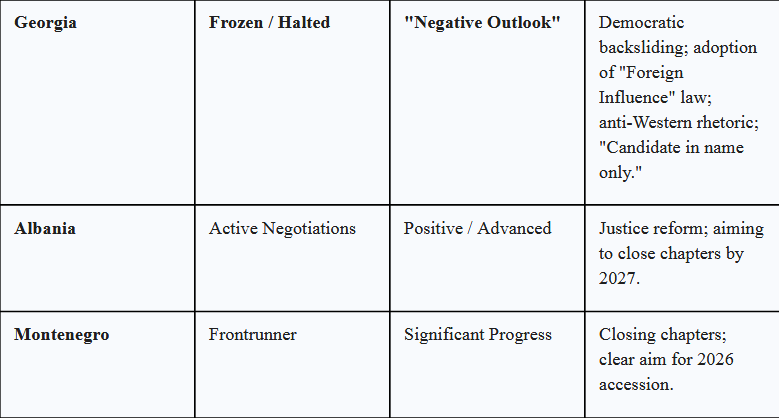
Source: Synthesized from European Commission 2025 Enlargement Package and EEAS Communications.
The divergence within the “Association Trio” (Ukraine, Moldova, Georgia) is stark. While Ukraine and Moldova have moved forward despite facing existential security threats and direct aggression, Georgia, enjoying a period of relative peace and economic growth, has regressed. The Commission’s report specifically highlighted that Georgia has “experienced serious democratic backsliding, with a rapid erosion of the rule of law and fundamental rights being severely restricted”. This creates a “grey zone” status for Georgia—technically a candidate, but operationally treated as a hostile non-aligned entity.
1.2 The “Nine Steps” and Systemic Non-Compliance
The conditionality for Georgia’s advancement was predicated on the implementation of “nine steps” outlined by the European Commission in November 2023. By late 2025, the assessment indicates not merely a failure to implement these steps, but active legislation to contravene them.
Combating Disinformation: Instead of fighting disinformation against the EU (Step 1), the Georgian authorities “systematically engaged in unprecedented, hostile anti-EU rhetoric,” often echoing narratives originating from the Kremlin regarding a “Global War Party”.
Political Depolarization: The government’s pledge to ban opposition parties upon securing a constitutional majority (which they failed to achieve but continue to threaten) and the imprisonment of opposition figures has exacerbated polarization to levels approaching civil conflict.
Institutional Independence: The abolition of the Special Investigation Service and the instrumentalization of the Anti-Corruption Bureau to target civil society represent a direct dismantling of independent oversight.
Free and Fair Elections: The conduct of the October 2024 elections, detailed in Section 2, was deemed incompatible with the standards expected of a candidate country.
1.3 The 2028 Suspension Announcement
In a definitive move that clarified the government’s strategic intent, Prime Minister Irakli Kobakhidze announced in November 2024 that Georgia would suspend its EU accession negotiations until the end of 2028. Furthermore, the government stated it would refuse EU budgetary grants, framing them as tools of foreign interference. Kobakhidze argued this was necessary to prevent “blackmail” and to ensure Georgia joins the EU on its own terms by 2030—a timeline viewed as mathematically and politically impossible by Brussels given the current freeze.
This announcement was the trigger for the “Second Wave” of mass protests (discussed in Section 4). It effectively signaled to the Georgian population and the international community that the GD government prioritizes sovereignty from Western oversight over integration into Western markets and institutions. The decision was characterized by the European Council as a “regrettable” move that undermined the constitutional commitment to EU integration, a goal supported by over 80% of the Georgian populace.
Section 2: The 2024 Parliamentary Election — The Legitimacy Crisis
2.1 The “War vs. Peace” Referendum
The parliamentary elections of October 26, 2024, serve as the foundational event for the current crisis. The ruling Georgian Dream party framed the election not as a choice between policy platforms, but as an existential binary: “Peace with Georgian Dream” or “War with the Opposition”. Utilizing billboards contrasting images of devastated Ukrainian cities with peaceful Georgian towns, the ruling party successfully weaponized the electorate’s trauma from the 2008 war and fear of Russian aggression. This narrative proved more potent in mobilizing the party’s base than the opposition’s framing of the election as a choice between “Europe and Russia”.
Official results from the Central Election Commission (CEC) awarded Georgian Dream 53.92% of the vote, securing 89 seats in the 150-seat parliament. This result was immediately and fiercely contested. Four major opposition coalitions—Unity–National Movement, Coalition for Change, Strong Georgia, and For Georgia—collectively garnered 37.78% according to official tallies, but exit polls commissioned by opposition-aligned media (Edison Research, HarrisX) painted a drastically different picture, predicting an opposition victory with over 50% of the vote.
2.2 Forensic Analysis: Electoral Geography and Anomalies
A granular analysis of the voting patterns reveals a fractured nation, effectively dividing the country into “two Georgias.”
Urban Defeat: Georgian Dream lost the capital, Tbilisi, where it received approximately 42% of the vote compared to the combined opposition’s 46%. It also lost in Rustavi and among the diaspora, indicating a complete loss of the urban middle class and youth vote.
Rural Dominance: The margin of victory was delivered by overwhelming support in rural regions and ethnic minority enclaves. In Samtskhe-Javakheti (a predominantly Armenian-populated region) and Kvemo Kartli (predominantly Azerbaijani), GD secured between 67% and 87% of the vote.
International observers, including the OSCE/ODIHR, noted that while the elections were “competitive,” they were marred by “widespread and consistent allegations of intimidation, vote-buying, pressure on candidates… and an uneven playing field”. The “statistical tail” of the results in rural areas—where turnout and GD support spiked in correlation—raised credible suspicions of a complex rigging scheme involving administrative resources and identification card manipulation, a claim central to the opposition’s refusal to take their parliamentary seats.
Table 2.1: 2024 Parliamentary Election Results Breakdown (Official vs. Exit Polls)
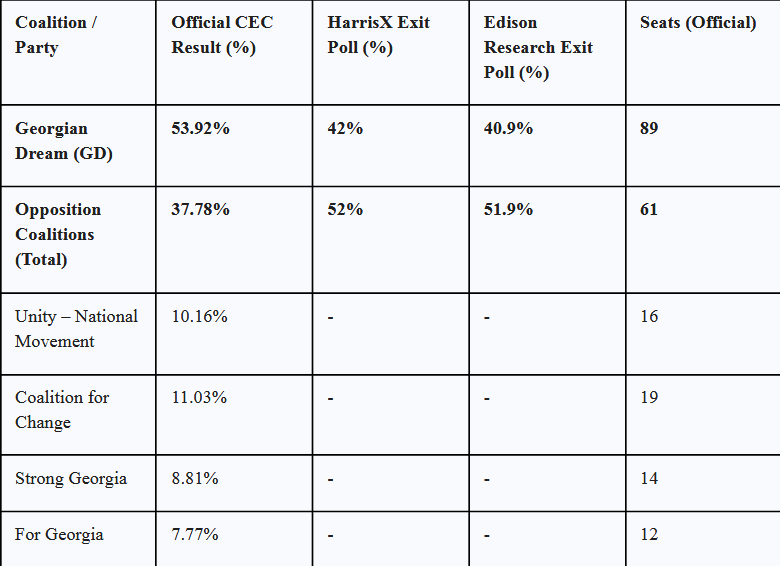
Source: Civil.ge, Central Election Commission of Georgia.
2.3 The Boycott and the “One-Party” Parliament
Following the election, the opposition coalitions signed the “Georgian Charter,” initiated by President Salome Zourabichvili, pledging to annul the results and refuse their mandates. Consequently, the new parliament convened in late 2024 with only Georgian Dream MPs present. This created a crisis of legitimacy; while GD holds the legal reins of power, it governs a capital city that voted against it and faces a parliament devoid of pluralistic representation. The European Parliament passed a resolution rejecting the legitimacy of the results and calling for a rerun within a year, further isolating the legislature internationally.
Section 3: The “Foreign Influence” Era — Legalizing Repression
The defining legislative achievement of the Georgian Dream government in 2024–2025 has been the successful implementation of the “Law on Transparency of Foreign Influence” (often referred to as the “Russian Law” by critics) and the subsequent “Law on Foreign Agents Registration” (GEOFARA). These laws serve as the primary mechanism for the state’s dismantling of civil society.
3.1 The Mechanism of the Law
Adopted on May 28, 2024, after overriding a presidential veto, the law requires any non-commercial legal entity or media outlet receiving more than 20% of its funding from abroad to register as an “organization pursuing the interests of a foreign power”.
Stigmatization: The terminology explicitly frames international aid—whether for agriculture, human rights, or election monitoring—as a vector of foreign subversion. This mirrors the rhetoric used in the Russian Federation’s 2012 “Foreign Agent” law.
Surveillance: The law grants the Ministry of Justice and the Anti-Corruption Bureau sweeping powers to conduct “monitoring” every six months. This includes the right to demand “highly sensitive information,” including personal data of beneficiaries, bank records, and internal communications.
Punitive Fines: Failure to register or submit financial declarations results in massive administrative fines. By late 2025, these fines were being actively levied. The law allows the Ministry to register entities unilaterally if they refuse to self-register, seizing their property to cover the fines.
3.2 Enforcement and the “Bank Freeze” Tactic
By late 2025, the theoretical threat of the law transformed into kinetic financial repression. The Anti-Corruption Bureau, led by GD loyalist Razhden Kuprashvili, utilized the law to declare key election-monitoring NGOs (such as Transparency International Georgia and ISFED) as entities with “declared electoral goals,” effectively subjecting them to political party financing rules which ban corporate donations.
When these organizations refused to comply with inspection demands that violated privacy standards, the Tbilisi City Court authorized the freezing of their bank accounts. In a significant escalation in late 2025, the Prosecutor’s Office froze the accounts of seven major CSOs (including the Civil Society Foundation and the Social Justice Center) under a “sabotage” investigation, alleging their funds were used to equip protesters. This move effectively decapitated the operational capacity of Georgia’s civil society, forcing many organizations to suspend operations or attempt to operate via cash, risking money laundering charges.
3.3 Broader Illiberal Legislation
The “Foreign Influence” law acts as the keystone of a broader arch of repressive legislation designed to consolidate conservative support and silence dissent:
Anti-LGBT Legislation: The “Family Values” law, passed alongside the foreign agent bill, imposes censorship on media coverage of LGBTQ+ issues and bans public gatherings deemed to promote “non-traditional” lifestyles. This legislation effectively outlaws Pride events and restricts educational materials.
The “Offshore Law”: Passed quietly, this allows for the tax-free transfer of assets from offshore zones to Georgia. Analysts interpret this as a mechanism for Bidzina Ivanishvili to repatriate his wealth to Georgia, shielding it from potential Western sanctions, thereby decoupling his personal fortune from Western financial systems.
Section 4: The 2024–2025 Protest Movement — The “Year of Resistance”
4.1 Chronology of Unrest
The period from November 2024 to December 2025 has been characterized by continuous, low-intensity resistance punctuated by high-intensity clashes. The protest movement has evolved from a spontaneous reaction to a sustained campaign of civil disobedience.
Phase I (Nov–Dec 2024): Triggered by Prime Minister Kobakhidze’s announcement of the suspension of EU talks. Tens of thousands occupied Rustavi Avenue. Police utilized water cannons, tear gas, and rubber bullets. Over 450 protesters were detained in the first two weeks alone.
Phase II (Winter/Spring 2025): The “War of Attrition.” Protests became decentralized. Students and cultural figures led “thematic marches.” The government criminalized the obstruction of traffic and banned face masks and pyrotechnics, tactics the protesters had used to defend against tear gas.
Phase III (Late 2025): The anniversary protests in November 2025 marked a resurgence. Despite police brutality and the “preventive arrests” of opposition leaders, thousands continue to gather, demanding new elections and the repeal of the foreign agent law.
4.2 State Response: “The Global War Party” Narrative
The government’s response to the protests has moved beyond simple crowd control to a comprehensive information warfare campaign. Georgian Dream leadership characterizes the protesters not as citizens with grievances, but as foot soldiers of the “Global War Party”—a conspiratorial entity they allege controls Washington and Brussels and seeks to open a “second front” against Russia in Georgia.
This narrative serves two purposes:
Delegitimization: It frames pro-EU aspirations as a foreign plot to destroy Georgia.
Justification of Force: It allows the police to treat protesters as “foreign agents” or saboteurs rather than political opponents.
Reports from human rights organizations (Amnesty International, Human Rights Watch) in 2025 confirm that police have used excessive force with impunity. Detainees report beatings in custody, and the “robbing” of protesters—where police confiscate phones and cameras to destroy evidence—has become standard practice. The Special Investigation Service (SIS), tasked with investigating police abuse, has been marginalized or, in some cases, its independence abolished.
Section 5: The Geopolitical Pivot — The China Vector and Anaklia Port
While severing ties with the West, Georgia has aggressively pursued a strategic partnership with the People’s Republic of China, most visibly through the revival of the Anaklia Deep Sea Port project. This infrastructure project has become the litmus test for Georgia’s new geopolitical orientation.
5.1 The Strategic Context of Anaklia
Anaklia is geographically critical. It is the only location on Georgia’s Black Sea coast capable of hosting a deep-water port to handle Panamax-class vessels. For years, it was envisioned as a Western-backed project (led by the TBC Bank-affiliated Anaklia Development Consortium) that would anchor Georgia in the Euro-Atlantic security architecture and serve as a logistics hub for NATO if necessary. The government’s cancellation of the TBC contract in 2020 and the subsequent arrest of its founders were the first tremors of the current geopolitical shift.
5.2 The Chinese Takeover (2024–2025)
In May 2024, the Georgian government announced that a Chinese-Singaporean consortium had won the tender for the port’s 49% private stake (the state retains 51%). The consortium is led by China Communications Construction Company (CCCC).
The Actor: CCCC is a Chinese state-owned giant. Crucially, it is sanctioned by the US Department of Commerce and listed on the US Treasury’s Non-SDN Chinese Military-Industrial Complex Companies List (CMIC) for its role in constructing militarized artificial islands in the South China Sea.
The Controversy: The US Embassy in Tbilisi and international analysts warned that handing critical infrastructure to a CCP-backed entity compromises Georgia’s sovereignty and allows China to control a key node of the “Middle Corridor” (the trade route connecting China to Europe bypassing Russia). The US Helsinki Commission expressed grave concern that Georgian Dream was “surrendering control” of the port to a US-sanctioned conglomerate known for “shoddy construction, labor abuses, and environmental damage”.
5.3 Construction Status in Late 2025
Despite the geopolitical fanfare, progress on the ground remains ambiguous and fraught with contractual complexities.
Dredging vs. Building: While Prime Minister Kobakhidze inaugurated “construction” in October 2024, the actual work in 2025 has been limited mostly to marine dredging. This work was awarded to a Belgian company, Jan De Nul, likely to provide a veneer of European participation and technical competence that the Chinese consortium might struggle to deploy immediately due to sanctions risks.
Contractual Limbo: As of late 2025, reports suggest the final investment contract with CCCC is still fraught with delays, though the Chinese side remains the “winner.” Opposition figures argue the delay is due to Chinese demands for sovereign guarantees the state is hesitant to sign publicly, or potentially due to the complexities of navigating US sanctions.
State Financing: The Georgian state has allocated significant budget resources to the project, intending to maintain a 51% controlling stake. This ensures the government retains ultimate authority, but critics argue it also places the financial risk on the Georgian taxpayer while the geopolitical benefits accrue to Beijing.
Nevertheless, the geopolitical signal is clear: Georgia has entrusted its most strategic asset to America’s primary global rival, effectively ending the prospect of Anaklia serving as a US/NATO naval asset in the Black Sea.
Section 6: Energy Security — The Black Sea Submarine Cable Paradox
Amidst the political rupture with the West, one major project remains technically “alive,” representing the EU’s desperate need for energy diversification and the complex interdependence that still binds Brussels and Tbilisi: the Black Sea Submarine Cable.
6.1 Project Specifications and Strategic Intent
The project envisages a 1,155 km high-voltage direct current (HVDC) cable (1,115 km submarine) connecting the electricity grids of the South Caucasus (via Georgia) to the EU (via Romania and Hungary).
Capacity: 1,300 MW (1.3 GW).
Goal: To export green energy (primarily wind and solar) from Azerbaijan and Georgia to Europe, bypassing Russia and reducing the EU’s reliance on fossil fuels.
Cost: Estimated at €2.3 billion to €3.5 billion, making it one of the most ambitious energy infrastructure projects in the world.
6.2 The Status of Funding and Politics (2025)
Herein lies the central paradox of EU-Georgia relations in 2025: The EU has frozen government-to-government aid and political dialogue, but has not cancelled the Black Sea Cable.
PMI Status: In late 2025, the European Commission retained the project on the list of “Projects of Mutual Interest” (PMI). This status allows for accelerated permitting and eligibility for Connecting Europe Facility (CEF) funding.
Progress: Feasibility studies by the Italian firm CESI were completed in 2025, confirming the project’s technical viability. Seabed surveys are ongoing.
The Conflict: The EU is in the awkward position of funding a strategic megaproject that relies on the cooperation of a government (Georgian Dream) it considers to be dismantling democracy. Conversely, GD uses the cable as leverage, calculating that the EU’s hunger for green energy outweighs its concerns over human rights.
The World Bank continues to support the feasibility phase, with disbursements continuing through 2025. However, the project completion date is estimated for 2029–2030, meaning its immediate impact on Georgia’s political isolation is limited to providing a lifeline of technical engagement.
Section 7: The “Nuclear Option” — Visa Suspension and Economic Sanctions
As diplomatic notes and political freeze failed to alter Tbilisi’s course, the EU moved toward utilizing its most potent leverage: the Visa Suspension Mechanism. This represents the most direct threat to the daily lives of Georgian citizens and the country’s economic stability.
7.1 The New Suspension Rules (November 2025)
On November 17, 2025, the Council of the EU adopted amendments to the visa-suspension regulation, significantly lowering the threshold for triggering a suspension.
Political Trigger: Previously, suspension required a statistical surge in illegal migration or security threats. The new rules allow suspension if a country’s “relations with the EU deteriorate,” including cases of “serious human rights violations” or “insufficient alignment with EU visa policy”.
Easier Activation: The statistical threshold for irregular migration or asylum claims was lowered from a 50% increase to a 30% increase, making it significantly easier to trigger the mechanism based on migration data alone.
Duration: The initial suspension period was extended from 9 months to 12 months, with a possible extension of another 24 months, creating a potential 3-year lockout.
7.2 The Threat to Ordinary Georgians
While the EU initially suspended visa-free travel only for holders of diplomatic passports in January 2025, the new rules in late 2025 pave the way for a suspension affecting ordinary citizens. This would be a catastrophic blow to the Georgian middle class and the concept of European integration.
Government Reaction: Georgian Dream has preemptively framed this potential suspension as an act of aggression. Prime Minister Kobakhidze dismissed the threat, stating that visa-free travel is “not an existential issue” and that the “Global War Party” is using it to punish Georgians for choosing peace. The government argues that if the visa regime is suspended, it will be an unjustified political act rather than a technical necessity.
Economic Impact: The suspension of EU financial assistance (over €121 million frozen) and the potential loss of visa-free travel (which facilitates remittances, business ties, and seasonal labor) threatens to isolate Georgia’s economy. Remittances from the EU are a vital lifeline for many families; restricting travel would sever this link, making the economy further dependent on Russia and China.
7.3 Sanctions on Individuals
By October 2025, over 200 Georgian officials, including judges, prosecutors, and police commanders, had been sanctioned by the US (visa restrictions) and select EU member states (Baltic states, Germany). These sanctions target the “enforcers” of the regime.
However, the EU as a bloc has struggled to impose unanimity-based sanctions on top oligarchs like Bidzina Ivanishvili due to internal disagreements (likely Hungary’s veto). This has led Brussels to rely on the visa-suspension tool, which requires a lower voting threshold (qualified majority) rather than unanimity, making it a more viable political weapon.
Section 8: Regional Implications — A Fractured Caucasus
The “structural shift” referenced in this report’s title refers to the inversion of the South Caucasus geopolitical map. The region is undergoing a realignment where traditional alliances are being upended
Table 8.1: The Inversion of Alignment (2020 vs. 2025)

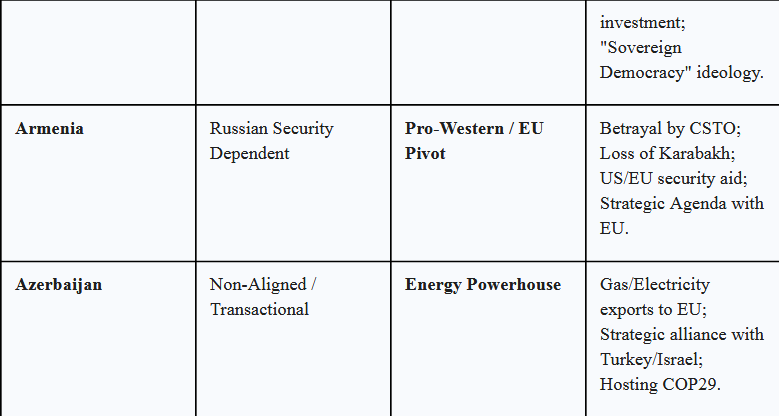
8.1 The Georgia-Armenia Switch
Historically, Georgia was the West’s foothold, and Armenia was Russia’s proxy in the region. In 2025, this dynamic has flipped. As Georgia freezes EU talks and drifts toward authoritarianism, Armenia is aggressively deepening ties with Brussels and Washington, receiving US aid, and exploring EU candidacy. This leaves Georgia as the “missing link” in the West’s regional strategy. If Georgia falls fully into the Russian/Chinese orbit, Armenia becomes a democratic island surrounded by authoritarian regimes, complicating the West’s logistics and support mechanisms in the region.
8.2 The Russian Factor
Moscow has watched Georgia’s drift with evident satisfaction. The restoration of direct flights, the influx of Russian capital, and the alignment of GD’s “sovereignty” rhetoric with the Kremlin’s worldview have thawed relations without a formal diplomatic reset. The Georgian government’s refusal to sanction Russia and its allowance of dual-use goods transit (alleged by the EU, though denied by Tbilisi) suggests a tacit non-aggression pact: Georgia stays neutral/compliant, and Russia refrains from further destabilization in the occupied territories of Abkhazia and South Ossetia. Russia sees Georgia’s “foreign agent” law and anti-LGBT legislation as evidence of Tbilisi returning to the “traditional values” sphere of influence.
Section 9: Economic Implications & Future Scenarios
9.1 The “Grey Zone” Economy
Georgia risks entering an economic “grey zone.” While trade with the EU remains significant (approx. €5 billion in 2024), the political freeze threatens to stifle foreign direct investment (FDI) from Western sources. The government hopes that Chinese investment in infrastructure (Anaklia) and Russian tourism/capital will offset this loss. However, this pivots the economy toward volatile and sanctioned markets, increasing long-term risks.
9.2 The 2026 Outlook
The year 2025 concludes with Georgia in a state of geopolitical purgatory. The “European Dream” enshrined in Article 78 of the Georgian Constitution is being systematically dismantled by the “Georgian Dream” party.
Key Findings:
The Rupture is Structural: The suspension of accession is not a bureaucratic delay but a reflection of incompatible governance models. As long as the “Foreign Influence” law and the current leadership remain, EU integration is effectively dead.
China is the New Patron: The Anaklia port deal signifies that Tbilisi is seeking security guarantees and economic patronage from Beijing to offset the loss of Western support.
Domestic Instability is Chronic: The legitimacy deficit of the 2024 parliament and the persistent street protests create a volatile environment. The government’s reliance on police force and financial repression (freezing NGO accounts) indicates a shift toward full authoritarian consolidation.
The Visa Trigger: The activation of the new visa-suspension mechanism in 2026 is the most likely “black swan” event. If triggered, it could either break the government’s support base or, conversely, be used by the government to finally sever the psychological link between Georgians and Europe, blaming Brussels for the isolation.
Strategic Recommendation:
The West must recalibrate its approach. “Strategic patience” has failed. The EU and US must decide whether to engage in transactional cooperation on energy (Black Sea Cable) while ignoring domestic repression, or to apply full-spectrum sanctions that risk pushing Georgia completely into the Russian sphere. The current halfway measure—freezing accession but maintaining trade—allows the Georgian Dream to survive while dismantling democracy.
Report compiled by: Eastern Digital Corridor (EDC)
Sources: Official EU Commission Reports, Civil.ge, OC Media, US State Department Declarations, Legislative Archives of Georgia, Amnesty International, Transparency International.
Works cited:
Overview: Georgia’s EU Accession Stalled as EU Issues Critical Assessment, accessed on December 10, 2025, https://georgiatoday.ge/georgias-eu-accession-stalled-as-eu-issues-critical-assessment/
2025 Communication on EU Enlargement Policy (extract about Georgia) – EEAS, accessed on December 10, 2025, https://www.eeas.europa.eu/delegations/georgia/2025-communication-eu-enlargement-policy-extract-about-georgia_en?s=221
Georgia ‘Candidate Country in Name Only’ – EU Commission …, accessed on December 10, 2025, https://civil.ge/archives/709546
EU calls Georgia ‘candidate in name only’ in damning 2025 enlargement report – OC Media, accessed on December 10, 2025, https://oc-media.org/eu-issues-2025-enlargement-report-says-georgia-is-a-candidate-country-in-name-only/
THE EU AND GEORGIA – Enlargement and Eastern Neighbourhood, accessed on December 10, 2025, https://enlargement.ec.europa.eu/document/download/76f6009a-4bbb-4d57-a93d-1ddb48501ec1_en?filename=Georgia+country+fiche+FINAL.pdf
EU Council Approves New Rules for Visa-Free Suspension Amid Concerns Over Georgia, accessed on December 10, 2025, https://civil.ge/archives/711082
Can China revive Georgia’s long-stalled Anaklia Port, and at what …, accessed on December 10, 2025, https://oc-media.org/can-china-revive-georgias-long-stalled-anaklia-port-and-at-what-cost/
Anaklya Port and Great Powers: Competition Over the New Eurasian Gem, accessed on December 10, 2025, https://rsdi.ae/en/publications/anaklya-port-and-great-powers-competition-over-the-new-eu rasian-gem
2025 Enlargement package shows progress towards EU membership for key enlargement partners – European Commission, accessed on December 10, 2025, https://ec.europa.eu/commission/presscorner/detail/en/ip_25_2584
2025 Enlargement Package shows progress towards EU membership for key enlargement partners | EEAS – European Union, accessed on December 10, 2025, https://www.eeas.europa.eu/delegations/georgia/2025-enlargement-package-shows-progress-towards-eu-membership-key-enlargement-partners_en?s=221
EU Report Slams Georgia For Democratic Backsliding, Highlights Progress In Other Candidates – RFE/RL, accessed on December 10, 2025, https://www.rferl.org/a/eu-report-slams-georgia-democratic-backsliding-progress-candidat es/33580249.html
Georgia: Court order on five independent NGOs a blow to freedom of association, accessed on December 10, 2025, https://www.amnesty.org/en/latest/news/2025/06/georgia-court-order-on-five-independent-ngos-a-blow-to-freedom-of-association/
Georgia at a crossroads: October 2024 parliamentary elections – European Parliament, accessed on December 10, 2025, https://www.europarl.europa.eu/RegData/etudes/BRIE/2024/762474/EPRS_BRI(2024)762 474_EN.pdf
Official Results of 2024 Vote: What They Show – Civil Georgia, accessed on December 10, 2025, https://civil.ge/archives/631386
Accession of Georgia to the European Union – Wikipedia, accessed on December 10, 2025, https://en.wikipedia.org/wiki/Accession_of_Georgia_to_the_European_Union
Georgian Dream to halt EU membership bid – OC Media, accessed on December 10, 2025, https://oc-media.org/georgian-dream-to-halt-eu-membership-bid/
As Georgians Protest Election Results, What Next? | Carnegie Endowment for International Peace, accessed on December 10, 2025, https://carnegieendowment.org/russia-eurasia/politika/2024/10/georgia-elections-results?lang=en
2024 Georgian parliamentary election – Wikipedia, accessed on December 10, 2025, https://en.wikipedia.org/wiki/2024_Georgian_parliamentary_election
GEORGIA OPINION ON THE LAW ON THE REGISTRATION OF FOREIGN AGENTS, THE AMENDMENTS TO THE LAW ON GRANTS AND OTHER LAWS RELATING TO – Venice Commission of the Council of Europe, accessed on December 10, 2025, https://www.venice.coe.int/webforms/documents/default.aspx?pdffile=CDL-AD(2025)034-e
Authorities Freeze Bank Accounts of Seven NGOs in ‘Sabotage’ Criminal Probe – Civil Georgia, accessed on December 10, 2025, https://civil.ge/archives/698002
Civil Society Under Pressure: The Georgian Case – The Advocates for Human Rights, accessed on December 10, 2025, https://www.theadvocatesforhumanrights.org/News/A/Index?id=597
2024–2025 Georgian protests – Wikipedia, accessed on December 10, 2025, https://en.wikipedia.org/wiki/2024%E2%80%932025_Georgian_protests
Georgia marks a year of protests – Global Voices, accessed on December 10, 2025, https://globalvoices.org/2025/12/07/georgia-marks-a-year-of-protests/
Georgia marks a year of protests since EU talks stalled and crackdown intensified, accessed on December 10, 2025, https://ca.news.yahoo.com/georgia-marks-protests-since-eu-182915007.html
Time to Fix the Broken Phone: How the Western Response to GD’s Authoritarianism Failed to Achieve Results – GEOpolitics, accessed on December 10, 2025, https://politicsgeo.com/time-to-fix-the-broken-phone-how-the-western-response-to-gds-authoritarianism-failed-to-achieve-results/
World Report 2025: Georgia | Human Rights Watch, accessed on December 10, 2025, https://www.hrw.org/world-report/2025/country-chapters/georgia
Agreement Should Not Be Signed With Chinese CCCC On The Construction Of Anaklia Port – Vera Kobalia – BM.GE, accessed on December 10, 2025, https://bm.ge/en/news/agreement-should-not-be-signed-with-chinese-cccc-on-the-construction-of-anaklia-port-vera-kobalia
US Helsinki Commission: ‘We are concerned by Georgian Dream’s decision to hand over Anaklia port to China – Globalnews.ge, accessed on December 10, 2025, https://globalnews.ge/en/usa/1226-helsinkis-komisia-gvasfotebs-ocnebis-gadawyvetileb
EXCLUSIVE: Construction of Anaklia Port starts, spotlight on Jan De Nul – Dredging Today, accessed on December 10, 2025, https://www.dredgingtoday.com/2024/10/23/exclusive-construction-of-anaklia-port-starts-spotlight-on-jan-de-nul/
Belgian Company Jan De Nul Selected as Winner of Tender for Design/Construction of Marine Infrastructure of Anaklia Deep Sea Port, accessed on December 10, 2025, https://www.economy.ge/index.php?page=news&nw=2560&s=anakliis-grmawylovani-navsadguris-sazgvao-infrastruqturis-proeqtirebamsheneblobis-tendershi-gamarjvebulad-belgiuri-kompania-jan-de-nul-gamovlinda&lang=en
Georgia cuts funding for Anaklia deep-sea port in 2026 budget – DredgeWire, accessed on December 10, 2025, https://dredgewire.com/georgia-cuts-funding-for-anaklia-deep-sea-port-in-2026-budget/
Georgia’s top official details progress on Black Sea cable, Green Energy Corridor, accessed on December 10, 2025, https://caliber.az/en/post/georgia-s-top-official-details-progress-on-black-sea-cable-green-energy-corridor
The European Commission has included the Black Sea Submarine Cable Project in the list of Projects of Mutual Interest (PMI) – gse.com.ge, accessed on December 10, 2025, https://www.gse.com.ge/communication/news/2025/submarine-cable-project-in-the-list-of-projects-of-mutual-interest/
Implementation of the Black Sea submarine cable project is advisable – GBC.GE, accessed on December 10, 2025, https://www.gbc.ge/en/news/Economics-news/implementation-of-the-black-sea-submarine-cable-project-is-advisable
Azerbaijan’s Multilateral Green Energy Diplomacy : Powering Regional Integration Through the Caspian-Black Sea Green Energy Corridor – Baku Dialogues, accessed on December 10, 2025, https://bakudialogues.idd.az/articles/azerbaijans-multilateral-green-energy-diplomacy-31-07-2025
Black Sea Interconnection Cable Gains PMI Status in New EU Energy Package, accessed on December 10, 2025, https://caspiannews.com/news-detail/black-sea-interconnection-cable-gains-pmi-status-in-new-eu-energy-package-2025-12-3-0/
Azerbaijan diversifies energy sources to export to Europe – Ekonomi – CNA.al, accessed on December 10, 2025, https://www.cna.al/english/ekonomi/azerbajxhani-diversifikon-burimet-e-energjise-per-tu-eksportuar-ne-evrop-i405957
World Bank Document, accessed on December 10, 2025, https://documents1.worldbank.org/curated/en/099122324062010666/pdf/P169698-3bb1a1de-2a3c-4dca-babd-8873a3da7c34.pdf
EU adopts new rules for suspension of visa-free travel for third countries, accessed on December 10, 2025, https://euneighbourseast.eu/news/latest-news/eu-adopts-new-rules-for-suspension-of-visa-free-travel-for-third-countries/
EU Cracks Down on Visa-Free Travel Over Migration, Security – ETIAS.com, accessed on December 10, 2025, https://etias.com/articles/eu-cracks-down-on-visa-free-travel-over-migration,-security
Visa Liberalization Under Threat: The Responsibility of the Georgian Dream and the EU’s Legal Mechanisms – Gnomon Wise – Research Institute | Publications, accessed on December 10, 2025, https://gnomonwise.org/en/publications/review/285
EU-Georgia relations: State of play – European Parliament, accessed on December 10, 2025, https://www.europarl.europa.eu/RegData/etudes/ATAG/2025/772849/EPRS_ATA(2025)772849_EN.pdf
EU – Georgia Association Agreement and Visa Liberalization Under Question, accessed on December 10, 2025, https://www.cacianalyst.org/publications/analytical-articles/item/13890-eu-georgia-association-agreement-and-visa-liberalization-under-question.html
The battle for stability: geopolitical trends, connectivity and democratic resilience in the South Caucasus | Heinrich Böll Stiftung | Brussels office, accessed on December 10, 2025, https://eu.boell.org/en/2025/11/13/battle-stability-geopolitical-trends-connectivity-and-democratic-resilience-south
Russia’s Intentions and Actions in the Black Sea – Transatlantic Leadership Network, accessed on December 10, 2025, https://www.transatlantic.org/wp-content/uploads/2025/08/RSI-II-Russia-and-the-Black-Sea-final-report-May-30-2025-final-version.pdf
Georgia–European Union relations – Grokipedia, accessed on December 10, 2025, https://grokipedia.com/page/Georgia%E2%80%93European_Union_relations