SOUTH EASTERN EUROPE IN A 3D WORLD
By Tigran Khzmalyan
European Party of Armenia
Chairman and Chief Responsible for Armenia in EDC
In his speech, Tigran noted the importance of Europe not diminishing the importance of the Eastern Partnership countries. A strong Europe needs South Eastern Europe noted Tigran. As he himself noted, there is a struggle between authoritarianism and democracy in the South Caucasus.
Highlights of his speech:
“Dear friends, distinguished guests. It’s my pleasure and honor to represent my country at the forum of Ave Europa which looks like a funding of a new pillar to the beautiful ancient construction of our beloved Europe. Dare I remind you that Armenia was a funding member of what European Union is today. If you have seen the maps of Ancient Rome near Coliseum you could notice that only two countries mentioned there were the states in that historical period of time: the Roman republic itself, which was in process of turning into the Empire, and the kingdom of Armenia. Because neither Germany, not France or Britain had been real states in that time. Unfortunately, not even the Greece, which was occupied by Rome already. So if the idea of the European Union is based on the Corpus Juris Romanum, the system of public and private human rights codified in Ancient Rome about 1st century BC, then Armenia joint that civilization code in 66 BC when Armenian King Tigran the Second signed an agreement of friendship and alliance with Roman council Gnaeus Pompeius Magnus.
Therefore I object the common definition of our region as a Southern Caucasus and instead I suggest more precise and politically correct terminology – Southern Eastern Europe, or SEE to make it shorter. Currently it includes four countries: Ukraine, Moldova, Georgia and Armenia.
I have entitled my speech “South Eastern Europe in the 3D World”. So if I clarified my view of what is SEE, I would like to present a projection of the global size. The 3D World I am talking about does not consider the human optical perception of reality. It’s rather a description of existential absurd we are living in. The D’s here are the capital letters of two main political systems: Democracy and Dictatorship.
These two D’s reflect the basic contradiction of human history, at least as it is presented in common knowledge – from the school textbooks and newspaper articles to political propaganda and Hollywood movies.
The struggle between the Democracy and Dictatorship seems to be the core of historical events and current developments- from Ukraine to Iran, from Venezuela to China.
The worst tyrants in the world history were often and predominantly demagogues who used to hide their dictatorial ambitions behind democratic demagoguery. That was the point in Ancient Greece and Rome, that was true in Bolshevik Russia and Nazi Germany, that is true about Putin and Trump, Erdogan, you name the rest.
But I would not dare to waste your time by these obvious statements. My point is that a real threat for democracy is not dictatorship but demagoguery because it usually manifests itself as populist quasi democracy and deceives the people while discrediting the real democracy.
The sad, bad and ugly example of these developments could be seen nowadays in the Southern Caucasus that doesn’t allow it to become a real South Eastern Europe.
The most notorious case is Georgia which has deteriorated from a beacon of democratic reforms to the Russian client province in less than a decade. Partly, this failure was rooted in narcissistic nature of Georgian reformist President Sahakashvili who tried to implement democracy through dictatorial measures. However, what succeeded in Singapore did not work in Georgia because Sahakashvili failed to create a large democratic alliance and counted predominantly on his personality rather than on democratization of society. He alienated democratic opposition and Georgia became an easy target of Russian special services who isolated and discredited Sahakashvili replacing him with their puppet oligarch Ivanishvili. But the question I would like to ask here is not for Georgia but for Europe. Today, when Kaja Kallas fairly diagnosis Georgian Dream (the ruling party) as a tool of Russian intervention, the real issue is a disability of European institutions to support the fragile and vulnerable democratic opposition in the countries in transition like Georgia and Armenia, being limited by bureaucratic barriers and biased prejudice…
On the contrary, Putin’s Russia never limits itself in tools and methods in this geopolitical struggle. While Europeans spent billions supporting political reforms and social institutions , Moscow spends ten times less bribing the governments and oligarchs.
Unfortunately, my country is following the inglorious path of Georgian Dream, turning it into the Armenian Nightmare. We see the same fake enthusiasm and pathetic promises of Pashinyan’s government about European prospects and inspiration, while the grim reality demonstrates country’s growing dependence from Russia.
I represent the European Party of Armenia which initiated the adoption of EU accession law in Armenian Parliament last year. However, the government doesn’t implement the law, more than this, Pashinyan has destroyed the country’s democratic coalition and specifically isolated the European Party of Armenia banning our appearance on the national television and attacking us in his pocket media for our criticism of his collaboration with Putin dictatorship. And just like it happened in Georgia, the EU institutions fail again to disclose the fake promises and confusing the democratic process with demagoguery…
In few days the unprecedented chance will be given to Armenia by the European Political Community 8th summit yo be held in Yerevan. Could there a better opportunity for Armenian government to apply for the EU candidate state status?
I would love to be ashamed as a wrong prophet but I am sure Pashinyan won’t apply for EU membership this time too. Instead he makes a deal with Putin who guarantee him a support at the coming elections in June. The price of their support is his refusal to EU accession.
Meanwhile all my attempts to warn the EU delegation to Armenia, the European institutions about this political bluff still face the blind eye and deaf ear of Brussels bureaucracy that repeats the same mistake as it made in Georgia.
European perspective has no alternative for Armenia.
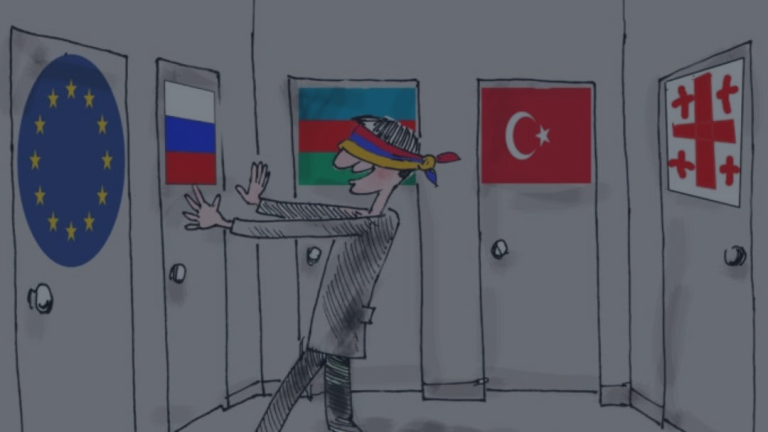
There is no salvation for Armenia outside Europe. But our current location here, in the castle of Ortenberg, reminded me Kafka’s novel The Castle, printed exactly 100 years ago, in 1926. If you remember, it is an allusion of a human’s struggle to find a shelter in the impregnable castle while he fears to knock and enter the closed door. In the end it turns out that the door of the castle was supposed to open specifically for him if he only dared to enter. He didn’t. In some sense, this is a common tragedy of lost communication…
I would like to ask whether Europe could remain the castle and fortress of freedom, Christian values and human rights without Armenia, without Georgia, without Ukraine, without South Eastern Europe. The answer is obvious for me. However, the question remains unanswered until is addressed by deeds, not by words.”