Written by the Chief of Department of Common Analysis of the Eastern Partnership
Joint Strategic Assessment: Q2 2026
Authors: Bhumyamca Hadi, Ranu Ahmadireja; Chief and Deputy Chief of the Department of Common Analysis of the Eastern Partnership
The structural integrity of the European Union’s energy security is currently undergoing a profound reevaluation, driven by the dual imperatives of the 2030 climate targets and the necessity for strategic autonomy in a multipolar world. As of early 2026, the geopolitical landscape has been fundamentally altered by systemic shocks, most notably the military escalations that led to the effective closure of the Strait of Hormuz on February 28, 2026.1 This event, which removed approximately 20 percent of the world liquefied natural gas (LNG) supply and between 25 percent and 32 percent of global seaborne crude trade, has acted as a transmission belt between regional conflict and global economic stability.1 For the Eastern Partnership (EaP) and the Mediterranean neighbors, this disruption is not a transient price spike but a signal that the era of reliance on vulnerable, distant maritime chokepoints must end. The Department of Common Analysis posits that the only viable path forward is the creation of a Green Energy Ring that integrates the renewable surpluses of the South Caucasus and the Mediterranean into a unified, resilient European grid.1
The transition toward a low-carbon, high-tech Europe rests on three fundamental pillars: the development of decarbonized energy at scale, the diversification of supply through low-carbon forms, including nuclear power, and the rebuilding of European industrial capacity through technological sovereignty. This report analyzes how the South Caucasus and Mediterranean countries can jointly accelerate this transition, focusing on the synergy between physical infrastructure, such as the Black Sea Submarine Cable (BSSC), and regulatory convergence through the Eastern Digital Corridor (EDC). By aligning the Middle Corridor transit architecture with the Mediterranean potential for green hydrogen, these regions can provide the baseload reliability and surplus capacity required to sustain European industrial leadership in the 21st century.
The Geopolitics of Energy Resilience in 2026
The contemporary energy crisis of 2026 has exposed the economic clock of war that governs global supply chains.1 The Eastern Partnership region (comprising Armenia, Azerbaijan, Georgia, Moldova, and Ukraine) finds itself at the epicenter of this shift. While the REPowerEU plan and the European Green Deal established the initial roadmap for diversification away from Russian fossil fuels, the subsequent closure of the Strait of Hormuz has created scarring effects that will persist long after a ceasefire.1 The redirection of global energy flows has made the South Caucasus not just a transit zone, but a primary source of green energy and a critical connector for Central Asian resources.
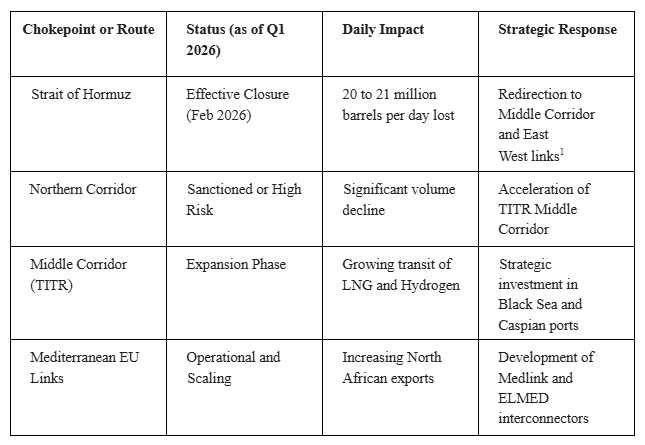
The analysis conducted by the Department suggests that the fragmentation of global markets has reached a tipping point. A patriotic Europeanism that emphasizes continental self sufficiency is emerging as a dominant response to systemic shocks. This ideology supports a transition that is both competitive and secure, rejecting the notion that environmental goals and economic growth are mutually exclusive.
The South Caucasus: A Hub for Renewable Export and Transit
The South Caucasus states possess geographic and climatic advantages that make them indispensable to the European green transition. Beyond their traditional role in the Southern Gas Corridor (SGC), these nations are now positioning themselves as producers of green electrons and green molecules.
Azerbaijan Green Shift and the Caspian Frontier
Azerbaijan has initiated a historic transformation from an oil-dependent economy to a diversified energy hub. Under the Azerbaijan 2030 National Priorities, the focus has shifted toward the Caspian Sea offshore wind potential, estimated by the World Bank at 845 GW. Of this total, 509 GW is located in shallow waters, allowing for the deployment of fixed bottom turbines at competitive costs. The Azerbaijani government’s goal of achieving 30 percent renewables in installed capacity by 2030 is supported by projects like the Khizi Absheron wind farm and the Bilasuvar solar plant.
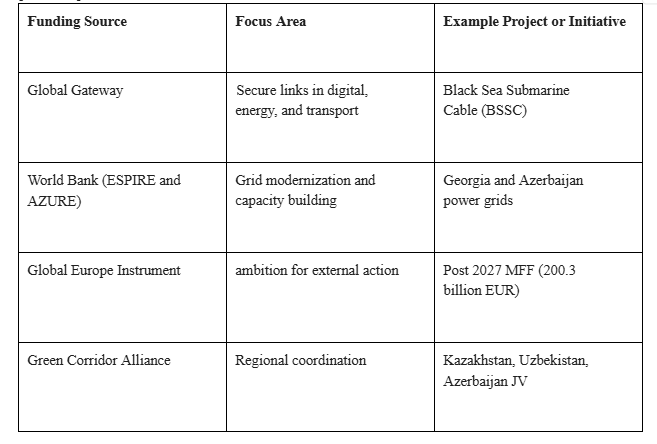
A significant milestone was reached on April 9, 2026, when Azerbaijan was approved for the issuance of International Renewable Energy Certificates (I REC E). This mechanism enables credible tracking of renewable generation, allowing producers to register on international platforms and enhancing the market value of green electricity exports. This is reinforced by the 173.5 million USD Scaling Up Renewable Energy (AZURE) project, which aims to modernize the national grid to integrate up to 1 GW of renewable capacity.3
Georgia’s Role as an Energy Bridge
Georgia is the linchpin of the East-West energy axis. Its significant hydropower resources and strategic location enable it to function as a regional balancer for intermittent renewable energy. The Enhancing Energy Security through Power Interconnection and Renewable Energy (ESPIRE) program, a multiphase initiative with a potential financing envelope of up to 500 million USD, is currently identifying subsea corridors and strengthening the domestic transmission grid.
The Black Sea Submarine Cable (BSSC) project, a flagship of the EU Global Gateway strategy, envisions a 1155 kilometer high voltage direct current (HVDC) cable (1115 kilometers of which will be underwater) connecting the Georgian grid at Anaklia with the Romanian grid at Constanta. With a capacity of 1300 MW and a voltage level of 525 kV, the BSSC will allow green energy from the South Caucasus to flow directly into the European market. In 2026, the project moved to the seabed survey stage supervised by the Italian consulting firm CESI.
Armenia and the Innovation Led Growth Model
Armenia’s energy strategy leverages high solar and geothermal potential while pursuing radical institutional reforms.4 A critical geopolitical development is the Trump Route for International Peace and Prosperity (TRIPP), designed to replace regional antagonism with economic cooperation between Armenia and Azerbaijan. TRIPP includes plans for fiber optic and electricity transmission lines crossing Armenia into Nakhchivan, creating a more resilient South Caucasus grid. The January 2026 implementation framework for TRIPP establishes a front office back office operating model for third-party private operators, ensuring infrastructure remains under Armenian sovereignty while facilitating cross-border energy flows.6
The Mediterranean Frontier: Decarbonized Interdependence
The Mediterranean basin is witnessing a reconfiguration of its energy architecture, driven by the emergence of Green Energy Corridors linking North Africa to the European core.
Greece and the Eastern Mediterranean Hub: Greece has utilized its strategic position to transform into a vital energy transit hub. The Eastern Mediterranean possesses enough renewable energy potential to generate approximately 144 percent of its projected 2050 electricity demand.7 To unlock this potential, Greece is investing in interconnectors and trilateral alliances with Cyprus, Israel, and Egypt. By creating economic interdependencies, the region can transform historical political tensions into a foundation for a sustainable regional energy community.
Italy and the Southern Bridge to Africa. Italy is consolidating its role as the primary bridge between the European continent and Africa’s renewable resources. The Medlink project, an HVDC interconnection designed to transfer 2 GW of renewable energy from Algeria and Tunisia to the Italian grid via a 525 kV bipolar link, represents a significant technological leap.8In parallel, the ELMED interconnector between Tunisia and Italy is a critical component of the Mediterranean Electricity Ring (MED RING).8 These projects are supported by the Pact for the Mediterranean, adopted in October 2025, which introduced the Trans Mediterranean Renewable Energy and Clean Tech Initiative (T MED) as a flagship coordination tool.
Synergies between the South Caucasus and the Mediterranean
The Department of Common Analysis identifies a Strategic Triangle consisting of the South Caucasus, the Mediterranean, and the European Union.
The Middle Corridor as a Green Hydrogen Route
The Middle Corridor (Trans Caspian International Transport Route) is no longer a fallback option but a central instrument for diversification. In the 2026 energy landscape, it serves as a vital route for the transportation of green electricity, renewable hydrogen, and green ammonia. Hydrogen can store energy from intermittent wind and solar sources in the Caspian and Central Asian regions and transport it to European industrial hubs. The EU hydrogen strategy aims to import 10 million megatons of renewable hydrogen per year by 2030, making the Middle Corridor essential for the security of supply.
Regulatory Convergence and the Eastern Digital Corridor (EDC)
A significant barrier to the trans regional transition is regulatory fragmentation. The EDC’s mission to support evidence-based digital and regulatory convergence is crucial for interconnected grids.10 This includes the harmonization of grid codes and cross-border trading protocols.7 The more for more approach of the European Neighbourhood Policy rewards partners who undertake reforms with deeper economic integration. On March 27, 2026, the Green Energy Corridor Power Company (GECO) signed a Memorandum of Understanding with the Italian firm Zhero to share expertise in large-scale corridors, building on the Medlink model.
Technological Sovereignty: Nuclear and Advanced Grids
Technological sovereignty involves reducing external dependencies while creating conditions for independence. In the energy sector, this requires a mix of renewables and low-carbon baseload sources.11
The Nuclear and Low Carbon Energy Mix
To sustain the energy intensity of semiconductor fabrication and AI data centers, Europe cannot rely on intermittent sources alone. The Department supports a nuclear first energy mix, including the development of Small Modular Reactors (SMRs) and advanced nuclear technologies. This offers a path toward decarbonization compatible with high-tech industrial growth.12
Digitalization and Smart Grid Interoperability Decarbonization and digitalization are mutually reinforcing.12 Smart grids are necessary to manage decentralized systems where prosumers both consume and produce electricity. Projects like the World Bank AZURE emphasize digitalization as a prerequisite for renewable integration.3
Financing the Trans Regional Infrastructure
The scale of the Green Energy Ring requires unprecedented investment through public de-risking and private capital mobilization.
Implementation Roadmap for the Green Energy Ring
1. Synchronization of Energy Platforms: The Union for the Mediterranean energy platforms and the EaP multilateral tracks should be integrated into a Neighborhood Energy Forum. 2. Establishment of a Common Economic Space: Lawmakers must facilitate the free movement of green energy and researchers through mutual recognition of technical documents. 3. Scaling Hydrogen Infrastructure: Prioritize the Middle Corridor for green hydrogen and ammonia from Central Asia to Europe.
4. Promotion of Technological Sovereignty Acts: Adopt a European Tech Sovereignty Act to streamline the building of gigafactories and SMRs.
5. Finalization of Financial Architecture: Complete the Banking and Capital Markets Unions to unlock private investment for large-scale projects.11
Conclusion
The convergence of the South Caucasus and the Mediterranean into a unified energy axis is the defining challenge for Europe in the mid 2020s. As of 2026, the global logistics landscape has been fundamentally altered, making the transition to a self-sufficient, decarbonized, and technologically sovereign continent a matter of civilizational survival.1 By building the Black Sea Submarine Cable and expanding the Middle Corridor, the EU and its neighbors can create a Federal Energy Union resilient to global shocks.
Works cited
1. Geopolitical and Strategic Impact of the 2026 Strait of Hormuz …, accessed April 24, 2026, https://easterndigitalcorridor.eu/geopolitical-and-strategic-impact-of-the-2026strait-of-hor muz-closure-on-the-easternpartnership/
2. REPowerEU – Energy – European Commission, accessed April 24, 2026, https://commission.europa.eu/topics/energy/repowereu_en
3. Azerbaijan, WB brainstorm synergy prospects to revamp power grid – Trend.Az, accessed April 24, 2026, https://www.trend.az/business/4146269.html
4. Renewable energy sources and energy security of Armenia, Azerbaijan and Georgia – MOST Wiedzy, accessed April 24, 2026, https://mostwiedzy.pl/pl/publication/download/1/renewable-energy-sources-and-energy-se curity-of-armenia-azerbaijan-and-georgia_110841.pdf
5. News | UNECE, accessed April 24, 2026, https://unece.org/ru/media/news?country=Armenia
6. Rewiring the South Caucasus: TRIPP and the New Geopolitics of Connectivity, accessed April 24, 2026, https://carnegieendowment.org/research/2026/03/rewiring-the-south-caucasus-tripp-and-th e-new-geopolitics-of-connectivity
7. Great sea connections: Financing the Eastern Mediterranean’s energy transition, accessed April 24, 2026, https://www.atlanticcouncil.org/in-depth-research-reports/report/great-sea-connections-fin ancing-the-eastern-mediterraneans-energy-transition/
8. New Energy Connections for a Sustainable Tomorrow – CESI, accessed April 24, 2026, https://www.cesi.it/app/uploads/2024/12/EJ-29-News-Energy-Connections.pdf
9. This action is funded by the European Union – Germany Trade and Invest, accessed April 24, 2026, https://www.gtai.de/:PRO201907115030
10. Eastern Digital Corridor, accessed April 24, 2026, https://easterndigitalcorridor.eu/
11. The Age of Converging Crises – And the Case for a Stronger Europe, accessed April 24, 2026, https://substack.com/home/post/p-166731066
12. Plenary coverage – European technological sovereignty and digital infrastructure 2025/2007(INI) – Substack, accessed April 24, 2026, https://substack.com/home/post/p-167921945